12 October 2007

It's the water

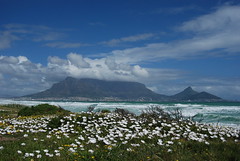
Table Mountain flowers (9) by Mark CT
It's always a bit of a shock when it really starts to rain again. After a few months of summer the mind rebells at the concept of precipitation. You can tell who's a gardener today: everyone else is frowning.

Anyway, the first rains here mean springtime in the Southern hemisphere. There are many ways to suffer vicariously through the cruelest antipodean month; start with a flickr search for Table Mountain.

Table Mountain Stream by Modest Al
Among other things, that search revealed the awesome picture to the right, which finally explains the mythically paradoxical "free-draining and moisture retentive soil" that they always tell us about. Also, the secret of success with Disa among other plants.


Labels: , ,

11 September 2007

Calochortus

I imagine that anyone who knows that they are interested in Calochortus has already ordered the new Calochortus book. Information on this genus has been hard to come by, with the exception of Frank Callahan's excellent review in Bulbs of North America. If you have held back for some reason, don't: this is a superb example of the genre I call the lay monograph, with a detailed description of the morphology, habitat, cultural information (rather limited for many of these rare plants), and publication history of all 73 species. There is a discussion of the first phylogenetic analyses of the genus, and even biographical sketches of the men (and a few women) who discovered and described these plants, which forms a short history of the botany of Western North America.

But will it interest those of you who don't already know you want to grow Calochortus? The book is worth it for Ron Parsons's 175 outstanding photographs, largely in situ. The only reasonable complaint is that these are mostly printed too small. Of course, pretty pictures of plants we can't grow don't normally top the list of the gardener's expenditures.

So why not try them?* The authors admit: "plants of this genus are much more challenging than common bulbs." For the majority of species, this is an understatement, especially in areas with summer rainfall. But the biggest problem is the difficulty of procuring most of these plants, even from seed.

The briefest glance at this book is going to make you throw caution to the wind and give it shot. These are crazy flowers, incredibly intricate and variable and beautiful (usually -- some species are frankly hideous). For obvious reasons, the easier species are easier to come by; anyone who can keep a pot dry in summer should try C. superbus or C. venustus. Get them at Brent and Becky's or Telos -- which has the best selection of species available anywhere.

And while you're waiting for your book, the flickr Calochortus group will give you an idea of what you're in for.

*The title of Kline's Calochortus article in the 1990 NARGS Bulletin. I stole it because it reminded me of America.

Labels: , , , ,

22 August 2007

Recovery

The latest Curtis's Botanical Magazine features an extraordinary illustration of the long-extinct Norfolk Island endemic Solanum bauerianum, reconstructed from Ferdinand Bauer's original drawings by Marion Westmacott:

Solanum bauerianum As with all his expedition field drawings, those of Solanum bauerianum are marked with numbers referring to a colour-code, each number referring to a different shade. Bauer used simple codes when working in Europe, that with 150 shades being preserved in the Real Jardín Botánico in Madrid, though a more elaborate one with 250 shades used for drawings to become Sibthorp’s Flora Graeca, has never been found (Lack & Ibáñez 1997, Lack 1999). For his Pacific work, Bauer devised a system with a thousand shades [emphasis mine]. Although it is also lost (if it ever existed in full), it has been possible (Pignatti-Wikus et al. 2000), by comparing the real colours of living plants in Western Australia with the numbers (2–994) used in extant Bauer sketches of the same species there, to reconstruct it.

There were a hundred different shades each of red, purple to pink, pink to mauve, and lilac and violet to blue, two hundred shades of green, a hundred each of yellow, orange, brown and white through grey to black. He also used cryptic abbreviated German and English words to designate texture and shininess. Bauer prepared a field sketch from living material before it faded, adding the numbers to indicate the colour shades to be used later to work up the finished drawing in watercolour. Such an elaborate code seems never to have been used by any other artist. Unwieldy as it seems, it allows the most sensitive depiction of colours of the living plant.

David Mabberley, Erika Pignatti-Wikus, and Christa Riedl-Dorn, "An Extinct Tree 'Revived'," Curtis's Botanical Magazine 24 (3) (2007), 190–195. At Blackwell-Synergy.

Note that the article is copyrighted by everyone, including Kew and Blackwell, and the illustration presumably by Marion Westmacott as well. Certainly Curtis's deserves credit for their work, which is not cheap for obvious reasons, but the danger is that such a rare publication will remain unknown to its audience. Anyway, the above is meant as a fair use indication of the interest of the article, the skill of the illustrator, and the excellence of the magazine, and why one might want to subscribe.

Although it isn't Bauer's sexiest work, his illustrations for Karl Friedrich Philipp von Martius's Historia naturalis palmarum, scanned by MOBOT, give a sense at least of his incredible precision.

Labels: , , , , , , , ,

03 July 2007

Dry

I read a lot of plant books, as you might have guessed. Approximately 90% of the ones that are worth reading are published by Timber Press. So I was eagerly anticipating their release of Martyn Rix's Subtropical and Dry Climate Plants. Rix is the editor of the best magazine ever.

Despite the unfortunate subtitle, there is nothing definitive about this book. It is rather an whirlwind tour of plants from around the world (many from not particularly dry climates). It makes no sense to yoke subtropicalness (both wet and dry) indiscriminately to dryness (both mediterranean- and monsoon-climate) like this unless the organizing principle is really: things Brits fantasize about growing in Cornwall or Chiantishire (or maybe after a few more years of global warming...)

This approach is both innocuously and insidiously shallow: UC Botanical Garden is called the "Berkeley Botanic Garden", and its "African Hill" the "Cape Rock Garden"; Brugmansia x candida certainly does not require "ample water" in summer in my subtropical garden. This problem is compounded by poor editing, in what I hope is not a sign of declining standards in the wake of Workman's acquisition of Timber last year. (I don't suppose I can blame the editors for spelling Rix's name wrong on their web page).

The organization is stupefying, with plants lumped into sections with names like "Acanthus, Monkey Flower and Related Shrubs" whose only principle is that they fit into a single spread. Thankfully there is a full index.

This organization makes it hard to assess the selection, but the list of both species and genera is idiosyncratic. This is actually the book's great strength: it is odd, for example, to ignore Penstemon completely (because the cvv. common in England are hybrids adapted to more temperate climes?), but the compensation is, say, two species of Bomarea (bizarrely located under "Chilean climbers"). Interesting taxa of common genera like Clematis cirrhosa and Dianthus 'Old Spice' are singled out at the expense of the "usual suspects" to be found in many such books.

But the main reason to buy this book is the photographs, something like 800 of them, almost all taken by Rix himself. Of course some of them are merely pedestrian, and the quality control on the printing leaves something to be desired, but the cumulative effect is a treasure trove of (mostly) subtropical plant porn. The text attached to them, notwithstanding the problems enumerated above, is a valuable bonus.

Labels: , , , , ,

04 May 2007

Pretty

Like bizarre flowers? I took some pictures at the Botanic Garden the other day.


Labels: ,

13 March 2007

Fun with flickr

flowers
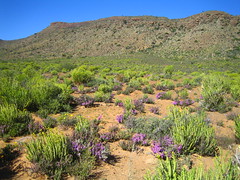
Beware flickr maps. It's easy to go a little crazy on the exotic flora. If you stare at the original size of this photograph taken near Nieuwoudtville ZA , you will eventually see hundreds of young Aloe dichotoma trees dotting the hillside. [The yellow-flowered succulents in the foreground might be a Hoodia or Euphorbia, and I have no idea about the purple (Ericas?)]. Poke around fjordaan's photostream for more shots of this wonderful tree.

Unless it's A. pillansii, but I think it's too far south.


Labels: , ,

© 2006