Natives
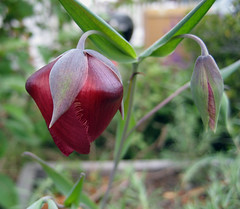
Also: fairy lantern!
2: If you liked reading about the Presidio manzanita, you'll love this unnamed species.
Labels: Calochortus, manzanita
posted by Anonymous at 5:33 PM
3 comments

Il faut cultiver nôtre jardin
Also: fairy lantern!
2: If you liked reading about the Presidio manzanita, you'll love this unnamed species.
Labels: Calochortus, manzanita
posted by Anonymous at 5:33 PM
3 comments
 I imagine that anyone who knows that they are interested in Calochortus has already ordered the new Calochortus book. Information on this genus has been hard to come by, with the exception of Frank Callahan's excellent review in Bulbs of North America. If you have held back for some reason, don't: this is a superb example of the genre I call the lay monograph, with a detailed description of the morphology, habitat, cultural information (rather limited for many of these rare plants), and publication history of all 73 species. There is a discussion of the first phylogenetic analyses of the genus, and even biographical sketches of the men (and a few women) who discovered and described these plants, which forms a short history of the botany of Western North America.
But will it interest those of you who don't already know you want to grow Calochortus? The book is worth it for Ron Parsons's 175 outstanding photographs, largely in situ. The only reasonable complaint is that these are mostly printed too small. Of course, pretty pictures of plants we can't grow don't normally top the list of the gardener's expenditures.
So why not try them?* The authors admit: "plants of this genus are much more challenging than common bulbs." For the majority of species, this is an understatement, especially in areas with summer rainfall. But the biggest problem is the difficulty of procuring most of these plants, even from seed.
The briefest glance at this book is going to make you throw caution to the wind and give it shot. These are crazy flowers, incredibly intricate and variable and beautiful (usually -- some species are frankly hideous). For obvious reasons, the easier species are easier to come by; anyone who can keep a pot dry in summer should try C. superbus or C. venustus. Get them at Brent and Becky's or Telos -- which has the best selection of species available anywhere.
And while you're waiting for your book, the flickr Calochortus group will give you an idea of what you're in for.
*The title of Kline's Calochortus article in the 1990 NARGS Bulletin. I stole it because it reminded me of America.
Labels: books, Calochortus, plantporn, review, Timber Press
posted by Anonymous at 11:00 PM
3 comments
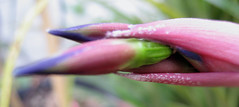
The Bilbergia that was threatening to bloom sometime in December was definitely slowed by the frost, but seems no worse for the wear. The pomegranate has leafed out, there are nascent buds on the Distictis buccinatoria and the Brugmansia has almost recovered all of the leaves lost in the frost. All we need is a little more rain.
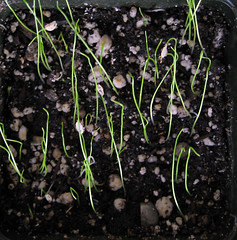
Away from the garden it was a horticulturally eventful weekend, with the Pacific Orchid Exposition (not really my thing) and a CalHort talk on Calochortus (great slides, not so much info). I learned of an amazing plant that I had to have, which, thankfully, turned out to be a myco-heterotroph. Cross that one off the list.
Labels: Bilbergia, Calochortus, seed, spring
posted by Anonymous at 1:47 PM
2 comments
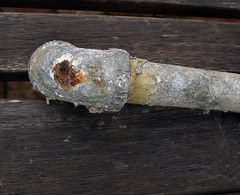
Did you know FUCK can be a six syllable word?
The water, we discovered 17 hours and several hundred dollars later, was gushing from this tiny pinhole in an elbow between floors [the crack noted above refers to what people were smoking when they decided that galvanized steel was a suitable material to deliver your water supply.]
Since Saturday was devoted to plumbing, Sunday was spent on the painting we were supposed to do Saturday, and gardening did not happen, despite an auspicious break in the rain yesterday.
I did have time to note a few developments, primarily monocotyledonous:
Labels: Asphodelus, Calochortus, crack kills, Dichelostemma, Erythronium, monocotypalooza, seed, shame
posted by Anonymous at 12:21 PM
2 comments
