31 July 2007

The miracle of life

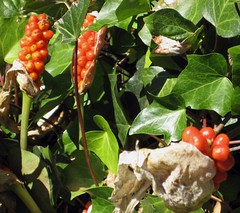
arum italicum berries
Honestly, I'm ambivalent at best on the arums, but as long as we're on the topic...

Everyday I see a "bed" of "landscaping" that consists of Ivy and trash (if that's not redundant). The Ivy is cut back maybe 3 times a year. But this hideous wasteland in fact harbors surprising biodiversity, not even counting the rats. Some kind of nightshady weed occasionally pokes its menacing berries through the groundcover, along with some brave, i.e. terrifyingly weedy, bindweed. But the interesting part is a stand of Arum italicum that has happily naturalized in this harsh environment. I can't tell if they were planted intentionally or not.

Last week I was staring at these ridiculous berries and contemplating the miracle of evolution: not only that such appealing things are produced from such a sinister plant, but the complicated and bizarre flowering apparatus that produced them (see the Dranunculus above [below]).

Anyway, I was wondering whether these berries are really appealing, or just bizarre, when some slack-jawed kid walked by and snapped off a stalk. Whether he carried it off as a gift for an unfortunate paramour, or simply as a distraction from his habitual stupefaction, no one can say. But is was a humbling example of natural selection in action.

And that is why I don't know if these arums were planted on purpose or not.


Labels: , , , , ,

09 January 2007

Horticultural therapy

Winter may have been mild so far, but don't try to tell that to my Agave attenuata, which looks about as vibrant as The Ohio State University's offensive line right now. Sorry, had to sneak a little football in there. Anyway, the agave will probably survive if I can manage to cover it before it gets really cold later this week, but it's not long for the open garden. I'm accepting suggestions for a hardier agave or aloe to replace it. Moderate spines only please.

Winter is a garden season here like any other, and though I'm pretty short on winter-flowering plants in my own garden, I went for a little walk the other day to see what's blooming. Most dramatic are the deciduous magnolias, of many varieties, with their huge, purple-flushed flowers on naked branches. There's some kind of rhododendron (I think) that I see all over the place). Camellias, of course, and aloes, particularly Aloe arborescens which seems to love it here. As far as traditional "winter interest" (i.e., not flowers) goes, there's the classic red-twig dogwood (Cornus sericea), one of which I noticed in the same yard with a "Sango kaku" Japanese maple, in a bizarre pigmented-branch smackdown.

Then my walk took a sinister turn. Whole lots carpeted with the monotonous pale yellow of Oxalis pes-caprae. This is the scariest weed I have ever dealt with. It goes to seed in days, and produces an apparently infinite number of corms ("bulblets"?) which instantly separate from the root if you try to pull it. Basically, any attempt to remove it succeeds only in spreading it. I have two weedy Oxalises: a dull yellow that I think is O. stricta, and a fleshy purple thing whose name I forget. The latter is particularly irritating, but it's nothing compared to the dreaded goat's foot. I'm fully prepared to nuke my neighbor's yard if it shows up there.

Oxalis pes-caprae

Anyway, despite the possibility of gardening, it's catalog time here just like the rest of the northern hemisphere. I thought I did pretty good to resist the blandishments of the (web-) famous Meliodendron xylocarpum (rare! beautiful! difficult! ... no room), until I moved on to the seed catalogs. Let's just say I bought an endangered penstemon endemic to Utah oil shales at 6000' [scroll down to P. grahamii]. That's going to love my yard. But the beauty of seed is that your failures set you back $3, not $30. And I'm hoping the endangeredness will inspire me to try a bit harder with the seeds this year. I need all the help I can get with seeds. (Of course, my source is cultivated plants, not the dwindling wild population. I'm not an animal.)

Labels: , , , , ,

© 2006